Why some songs have no single answer — and what to do instead
Short on time? Watch the demo of MusicPulse identifying an unofficial edit in real time.
Here is a sample of nine consecutive comments from a single thread:
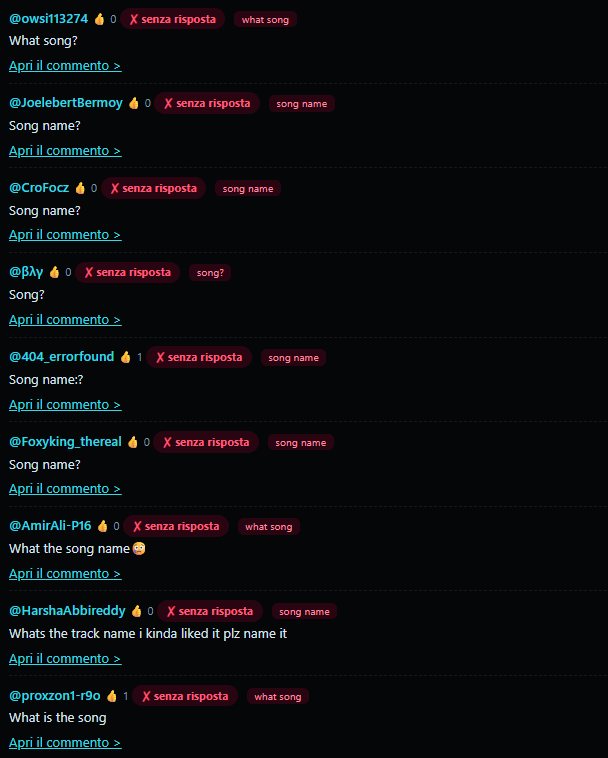
Read them in order: What song? · Song name? · Song name? · Song? · Song name? · what song · What the song name · Whats the track name i kinda liked it plz name it · What is the song.
Nobody is ignoring the question. That is the thing worth noticing. In a thread like this, every single person is quietly assuming somebody else will answer it, and so the question falls through. The last comment is the most honest one in the list: it is not really a question, it is someone admitting they liked a track and have no way to find it again.
1. Why nobody has the answer
The people in that thread are not being lazy. They are solving a problem that has no clean answer, and the reason is worth stating plainly before we get to any tool.
A track that circulates on short-form video is rarely one thing. The same audio might exist as the original release, a slowed version, a sped-up version, a nightcore edit, a pitched-down remix, and half a dozen unofficial uploads. If the video used the fourth one and you recognise the song, you still have not identified what you actually heard.
On top of that, plenty of viral edits were never released anywhere official. They live on a SoundCloud profile or a re-upload, never on Apple Music or Spotify. A fingerprint matcher can only return what is in the catalogue it checks, and for those edits the catalogue is empty.
So for a large share of viral audio, the honest answer is not a title. It is a shortlist.
2. What happens when you force a single answer
Most music identifiers resolve this ambiguity by picking one result and presenting it as fact. If the clip has been slowed or re-mastered, the matcher often returns the closest official track it can find.
That outcome is worse than no result, and not because it is rare. It is worse because it is plausible. A name with no hedging looks like an answer, so you do not think to doubt it. You go looking for that track, fail to find the sped-up version you were actually hearing, and conclude that your memory is the problem.
3. MusicPulse shows the shortlist instead
When the audio evidence is promising but not strong enough to call it an exact match, MusicPulse does not force the issue. It shows up to three candidates, each with its own confidence level and direct links to where that specific version actually lives.
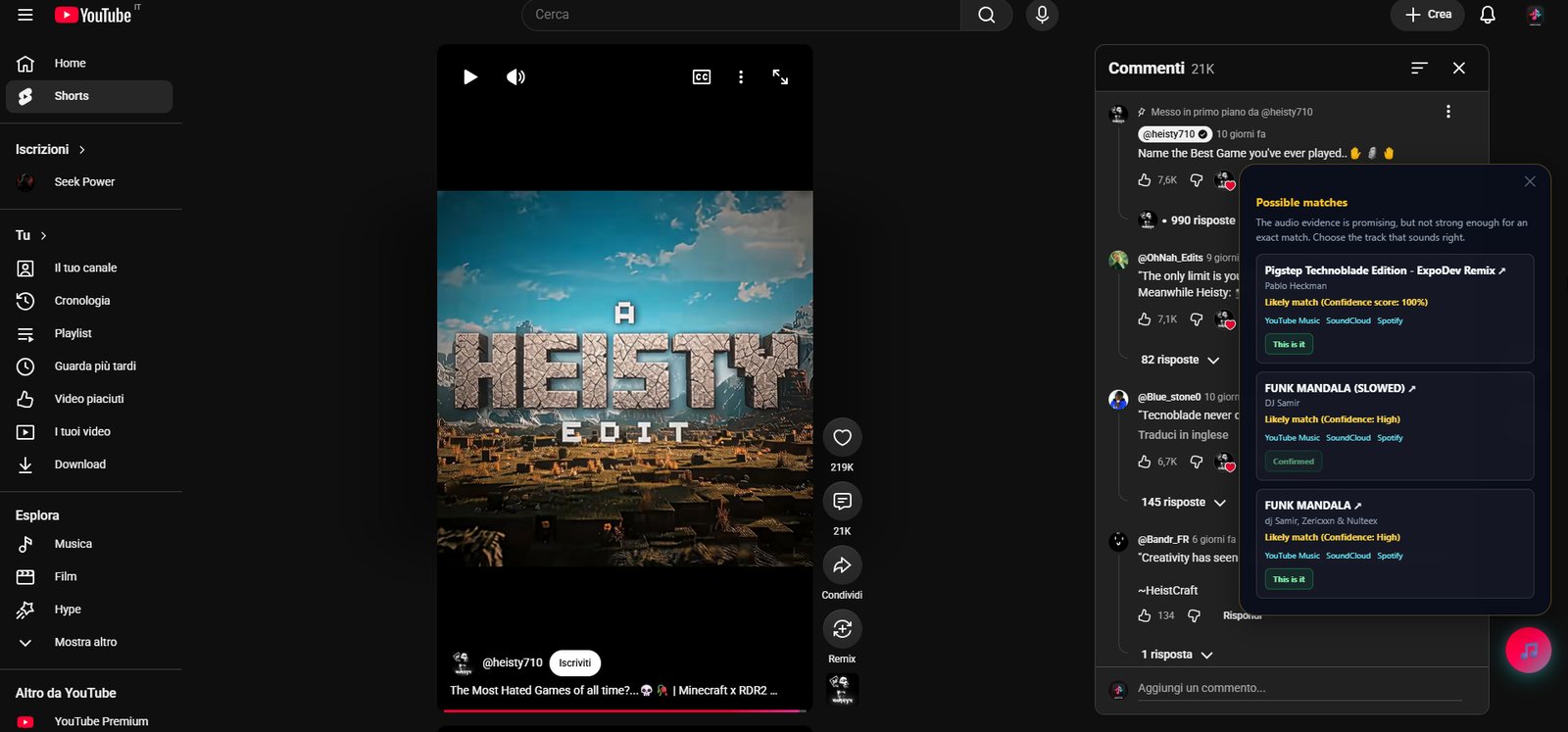
Here is a real example, taken from a Short with 219K likes and 21K comments. The video is a “Heist Edit” built around a Minecraft track, and YouTube labels its audio simply “Remix”:
Notice what the panel is not claiming. It does not say “this is the song.” It says the audio evidence is promising but not strong enough for an exact match, and it hands you three candidates ranked with their confidence level, so you can pick the one that sounds right in three seconds.
- Pigstep Technoblade Edition — ExpoDev Remix — ranked first, carrying the strongest confidence score.
- FUNK MANDALA (SLOWED) — a slowed version of a different track, still plausible.
- FUNK MANDALA — the original, kept in the list because the audio was close to it.
Every candidate carries its own version label, because “FUNK MANDALA” and “FUNK MANDALA (SLOWED)” are not the same recording. Each one links out to YouTube Music, SoundCloud and Spotify, so whichever you pick, you can hear the difference immediately instead of trusting a title.
About that confidence score
In the screenshot the top candidate reads “Confidence score: 100%”, and it is fair to ask what a hundred percent means here. It does not mean certainty, and any tool claiming certainty here would be lying.
It means that, on the strength of this particular audio, that candidate outranked the other two by the measured margin. It is a statement about the ranking, not about reality. The reason the panel still asks you to choose is precisely that the top score was not high enough to skip the question. A tool that treated 100% as a guarantee would be making the same mistake as the one-answer approach, only with a decimal point.
4. You get the last word
Each candidate carries a This is it button. Tap it and the match is confirmed. Mark one wrong and it is recorded as a miss.
Neither button exists for show. They are how the shortlist improves: confirmed matches and misses both feed back into the ranking, so the same ambiguity is handled better next time. In the screenshot above, the second candidate is already marked Confirmed — that is a decision the person scanning made, not something the tool decided on its own.
5. What this still cannot do
None of this works for audio that has no catalogue entry. Creator-uploaded original sounds, most “original audio” on short-form platforms, and unlicensed music have nothing for a fingerprint service to match against. No tool finds those, and none is going to.
When that happens MusicPulse says so rather than inventing a title. That is the same principle running through the whole product: a wrong answer costs more time than an admitted one, because you cannot check a claim you were never warned about.
The short version
If the audio clearly matches something in the catalogue, you get a title. If it clearly does not, you get a refusal. If it sits in between — which is where most viral edits live — you get three candidates with their confidence levels, links to the actual versions, and the decision back in your hands.